Showing posts with label travel. Show all posts

Monday, July 4, 2016

The More Things Change The More They Stay The Same..., or "Today's Lesson"


Good afternoon class. If we haven't met before, my name is Mr. Whitney. That's right, like the girl's name. Get your laughs out now. Before we begin, I want to know something, have any of you ever read any James Michener? No. Well I don't blame you. Today we are going to do a "reverse Michener". Instead of starting way back in time and building up to now, we are going to tear down the present and end up back at the end of the Ice Age. Sounds cool, right? Hey! Quit your groaning in the back, Kristina! Make sure you're paying attention, this will be on the test.....

   Okay, so now that the formalities are out of the way let's start with a little town called Fairbank, aptly named as it sits on a nice little spot along the banks of the San Pedro river in Southern Arizona. No one lives there anymore. It's a ghost town. Once it was a nice little mining town near Tombstone, famous for Wyatt Earp and the Clanton feud. Ike Clanton himself had a ranch nearby little Fairbank but that's another story. So here we are in 2016 and all that is left of Fairbank are some little wooden buildings, a cemetery, a rebuilt school house and the ruins of a large Silver Stamping mill. The school house was restored in 2007 and also houses a modest library and gift shop for visitors. It is maintained as a historic site by the Bureau of Land Management as part of the San Pedro Riparian Area. If you happen to visit, I highly suggest you see if Ron Stewart is the volunteer for the day. He is super nice and very knowledgeable. What's left of this little town is tucked away along a lonely stretch of highway between Whetstone and Tombstone, the buildings are huddled together beneath the shade of Cottonwoods and the humidity of the river.
The Fairbank Silver Mill
     Just under a mile away is a small cemetery, run down and decrepit. The perfect place to either bury a treasure or be haunted by an old cowboy's ghost. Your choice. The hill has been eroding for nearly a century since the last person was buried there, the wooden crosses have dry rotted and the stones that keep the dead in their tombs have began to migrate to greener pastures. Even further down the trail are the megalithic remains of an old Silver Mill. Here, the gravity of falling water generated enough steam and energy to forcefully move metal rods up and down, up an down, again and again, essentially grinding raw silver ore into dust. Now, all that's left are giant walls of mortared stone, a lasting testament to both man's ingenuity and greed.
     The real question is why do you think this town sprung up here? Anybody? *chirp chirp*. You, the blonde in the back with Doctor Who shirt. Yes you. What do you think? Very good! It's the river. The river is why they chose to build. As mentioned before, this town relied heavily on its Silver Mill, which of course used the coursing water of the San Pedro to do its job. The Mill brings workers, workers bring their families and then a town pops up. The Railroad comes to ship the goods and soon enough you have a hotel, a mercantile and schoolhouse. But eventually the rails decide to move elsewhere, the people run out of things to do and they all move on. It's the story of more little towns than one can probably count. At one point, the U.S. census states that there were a whopping 72 people living in Fairbank. A little strange because the Business Directory lists at least 242 in 40 households. During this time, the Census was not something to be trusted. Many people considered it government over reach and some just plain didn't want to be found. Fairbank was never very big by any means, Tombstone being only a 15 minute drive away, but it had its place in the web of the mining economy in Southern Arizona.
    Speaking of Tombstone, let me deviate for a second for a pretty cool story. Don't roll your eyes at me Mr. French. Wyatt Earp. Famous and/or notorious gunfighter of the Old West. Made popular by his shootout with the Clanton gang at the O.K. Corral in Tombstone, Arizona, was once tried for murder. Many thought that he wrongfully killed those men cold in the street, many had a less than positive perception of the man. They charged him with murder. Fearing that he would not get a fair trial in Tombstone, the judge had his trial moved to Fairbank. After news spread of Wyatt's charges, old acquaintances and friendly citizens of Dodge City, Kansas sent letters speaking highly of Earp's honor. Wyatt was eventually acquitted and the charges dropped. Prime example of how important it is to have a good reputation.
    Anyway, Fairbank was founded alongside the San Pedro because of the abundance of water. It lasted from 1881 to 1973. But what happened before? Any guesses? Susie, go ahead. There were Native Americans there? Well, you are not wrong, but there was something else in between. Ah, the Spanish. Awesome. So the Spanish had come to this area for the same reason. The land was rich and fertile because of the river valley. Fairbank was built within the boundaries of the San Juan Boquillas y Nogales Land Grant that was once owned and operated by the Elias family out of Sonora. They came into the land in 1823 and the Spanish intended to settle it as part of New Spain, or Mexico, by today's terms. They had a hard time of it because they weren't the only ones there. The Chiricahua Apache fought them every step of the way which led to the abandonment of the area, leaving nothing but thousands of wild cattle roaming the San Pedro River Valley. In 1854 this area became part of the United States after the Gadsden Purchase but wouldn't be settled until the founding of Tombstone, Charleston and Fairbank.
    So why were Spanish trying to ranch there? What made it good for such a thing? Andy? Very good, its the water. I think you are catching on to the pattern here.  The San Pedro River creates an area that is far more fertile than the surrounding Sonoran Desert. Water is a hot commodity in the desert and everything relies on it. Even today, the land around the river is filled with Cottonwood trees, Mesquite, marsh grasses and all kinds of wildlife that rely on the water found there. In 1695 Father Eusebio Kino visited a string of Apache villages just north of the ruins of Fairbank. 156 years earlier, in 1530, Fray Marcos de Niza explored the area for the King of Spain describing the area as "an irrigated, evergreen garden" (Friends of the San Pedro River). Again, its the water.
Prehistoric Pottery and Points
     Alright, one last thing, I promise. The time machine is going to start moving faster now. Before the miners, the Spanish and the Apache, there were others. The Hohokam, the Mogollon and the Salado cultures all had settlements alongside the San Pedro River. Before them was the Cochise Culture lasting from around 5000-200 BC. Before the Cochise still, we have the Clovis. Who can tell
me who the Clovis are? Red hair and glasses, in the front, what do you think? Perfect, the Clovis were one of the first major migrations into the Americas. This happened between 12-9,000 BC, give or take a few and low and behold, there they are right along the San Pedro River. Now the climate back then would have been much different from the desert that it is today, but regardless the water was very important. The San Pedro started flowing at the end the last Ice Age and would have attracted all kinds of animals including Megafauna. Near Fairbank is Murray Springs that has evidence of Mammoth and Bison Antiqus kills. Also along the River are the Naco and Lehrner Mammoth Kill sites, just a stone's throw away.
    Ah, a question Mr. Petro? What's the point of all this? Excellent, I was just getting to that. What have I told you again and again is the point of studying History? Not the names. Not the dates. History shows us the overarching themes of human interaction and existence. Now I know it seems obvious that people need water. Everything needs water. But today we have talked about some concrete examples of how people relied upon the San Pedro river for their lives and livelihoods. The river gave them game to hunt, grass to feed cattle, and power to run their mills. It brought food, settlers, miners, merchants, and families. This is a pattern that will ring true nearly everywhere in the world with only a few exceptions. Where there is water, you will find people. Even today, the San Pedro is a conservation area that attracts visitors and outdoor enthusiasts from all over. Ranches still dot the valley and other towns have sprung up. If you ever hope to understand people, history is where you need to begin. Thanks for paying attention today class...for the most part....except you Scott. I saw you sleeping over there. I'll see you after class. 


Saturday, June 25, 2016

Sing it from the Mountain Top, or "Too Far From the Beaten Path".


Top of the Mountain
   Since last time I wrote a post I have a lot of stuff go on in my life, all of it positive I might add, but still requiring a lot of thought processing. When I feel overwhelmed or stressed out, the best place for me is outdoors. I realize that there is a lot of talk about how the outdoors can help with things like depression and anxiety, and that might be true in some cases, but that is not true for everyone. But
Looking East from the Sandias
that's not necessarily what I am talking about. Being outside is like my meditation. Being surrounded by the Natural World refreshes sense of wonder and gives me some perspective. Its like meditation for me. Except I don't really know what that feels like because my mind wanders too much. But I can imagine there is a similarity. Maybe it's standing next to towering Ponderosa pines, hearing the wind blow through the the grass in a high mountain meadow, or making eye contact with a pair of deer as they nonchalantly pick their way through the brush; whatever it is, it brings me peace. As I mentioned before, big week for me. Lots to think about. Something in me decided to climb a mountain. So I did.
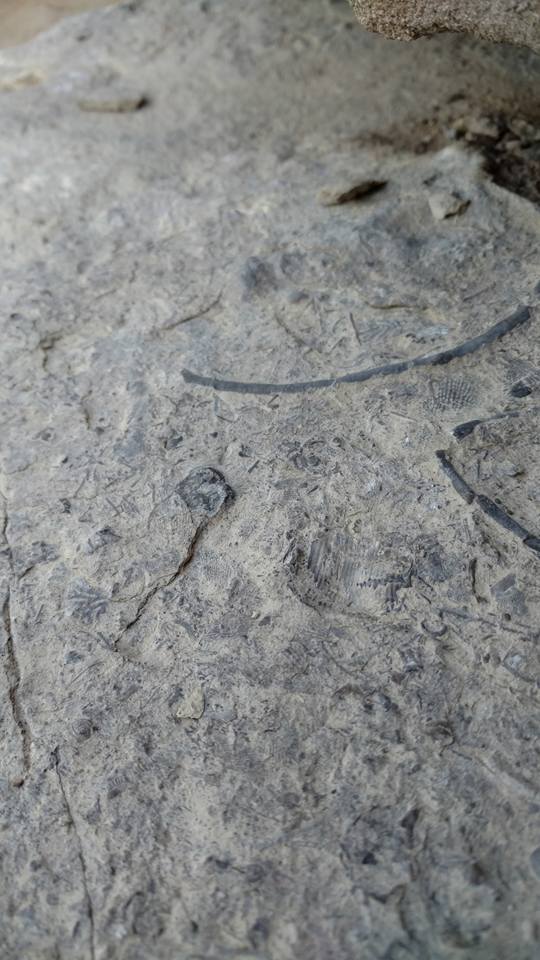
     I had been reading about interesting things in the area and read about an outcrop of limestone at the top the Sandias that supposedly had fossils. Nothing really special, mostly coral and small bivalves, but regardless, I wanted to see it. I could have driven to the top, parked, had a short, relaxing hike and been done. Did I do that? No. No I didn't. On a whim I parked just short of halfway up that bad boy and hiked. One of my favorite parts of hiking up a mountain is being able to go through all the different ecosystems that melt together as the elevation increases. The trail I chose began next to a small stream at the very top of Madera Canyon, it was a fairly modest trail, lacking in upkeep and only tenuously marked, making it all the more exciting. Looming above me, somewhere above the massive pines, was the peak that I sought to reach. The tail meandered up around the side the mountain, taking me through some truly beautiful stretches of forest. Unfortunately that was not the case the whole time.
     I spent a lot of time in my life working for a Nature Center in Nebraska where were basically in constant battle with Invasive Species. Sounds dramatic? Good. Because it was. Lost a lot of good
Prescribed burn back in NE
people out there. Stretches of the forest that I walked through were in really bad shape. Inches of duff (basically dead plant matter) covered the forest floor with barely any under story growth. In other places Scrub Oak blanketed the area in a near mono-culture. The mountain is in desperate need of a good burning. Fire was one of the most important aspects of managing our Prairie back home, and is also super important for keeping a healthy forest. I admit, I am not an expert in forest management and I realize there is a ton of planning an budgeting that goes into it. Problem is, unless you stay on top of it, the next time there is a fire it can be severe. Just a week or so ago, a large fire sprung up in the Manzano mountains southeast of Albuquerque. The Sandias are closer to an urban area and could potentially cause a greater loss of property and life if not contained in time. Thousands of years ago, lightening and mindful Native Americans made sure that fire did its part, whether it was intended or not. There are even a number of plants that will remain as seeds until fire coaxes them out. Fire is important, and it hurts my heart to see the forest in such bad shape.
Easiest way to read "Owls Hoot in the Daytime"
     Anyway, enough of the preaching. So I am about halfway to my destination and I stop to down some Powerade. What do I hear? An owl hoot in the daytime. First off, I freaking LOVE owls. Back at the nature center we had these two little screech owls and they were so cute and perched on my hand and then there was this blind Barn Owl and watching him eat was disgustingly fascinating. Second: "Owls Hoot in the Daytime" by Manly Wade Wellman is one of my favorite short stories ever! If you haven't had the chance to read it, find me and I will make sure you do. In the story, the owl calling out during the day signifies that the main character has traveled too far from the beaten
path. It is derived from old Appalachian folklore; I promptly ignored its warning and continued on.

     It was a long trek, not going to lie. I had to take a more than a few breathers because walking up hills is hard work. My eyes widened as I walked
Looking down from the top
into a wide open meadow very near the top. The top of the Sandias is a really popular hiking/trail running/dog walking area and I rapidly came to realize that I was not really in the wild anymore. My dreams of bear taming crushed for the day, I couldn't help but pick up some of the trash I came across in the trail to at least be placed in a trash can next time I saw it. I can forgive ill maintenance of the parkland, I get it, its hard, it costs money, and it can be really dangerous. You know what isn't any of those things? THROWING AWAY YOUR DAMN TRASH. Seriously. Put it where it belongs. Awesome, two preachy moments in one post.

      Anyway, eventually I made my way the highest point on the mountain and looked down and out across the world around me. Gods is it a beautiful sight. In moments like that, I am overwhelmed with a sense of place. That meditation thing I was talking about at the beginning. I knew where I was and for a moment my doubts and fears rushed away with wind. But I still had a goal. I had to find me some fossils. The age of the earth is profound to me. The fact that at the top of the mountain I am standing on what used to be the bottom of an ancient sea. Untold centuries of violent processes radically changed the shape of the surface into what I was seeing then. Talk about perspective. Looking out into the horizon, feeling the weight of time and pressing my hands against the remnants of some of the earliest lifeforms on the planet. People find solace in many things. Religion. Fantasy. Art. I find it most often in the feeling of insignificance. It is peaceful there. Maybe a bit lonely. But it's clarity. For me at least. I close my eyes and take a deep breath. I look up at the sky. Down at the world. Peace. The hike back down in way easier. I feel a little high. Maybe its the meditation, maybe its dehydration. Who knows. Aside from being stabbed in the side by a Yucca thorn, it was a good day.
Bottom of the Ocean


Wednesday, June 1, 2016

Woman of the World (and explantions for my hiatus)

Holy CRAP! I hate Grad School. Today was my last full class, I have my "Exit Interview" tomorrow and then I am freaking done. Like waaaay more done than I am with this beer next to me. Anyway....rough couple of semesters....blah blah blah....that means I now I have time to write more! I am going to start this off by cheating. By cheating, I mean posting something I didn't write. But I did ask the author to write it for my blog (because she posts less often than I do). So there, take that.

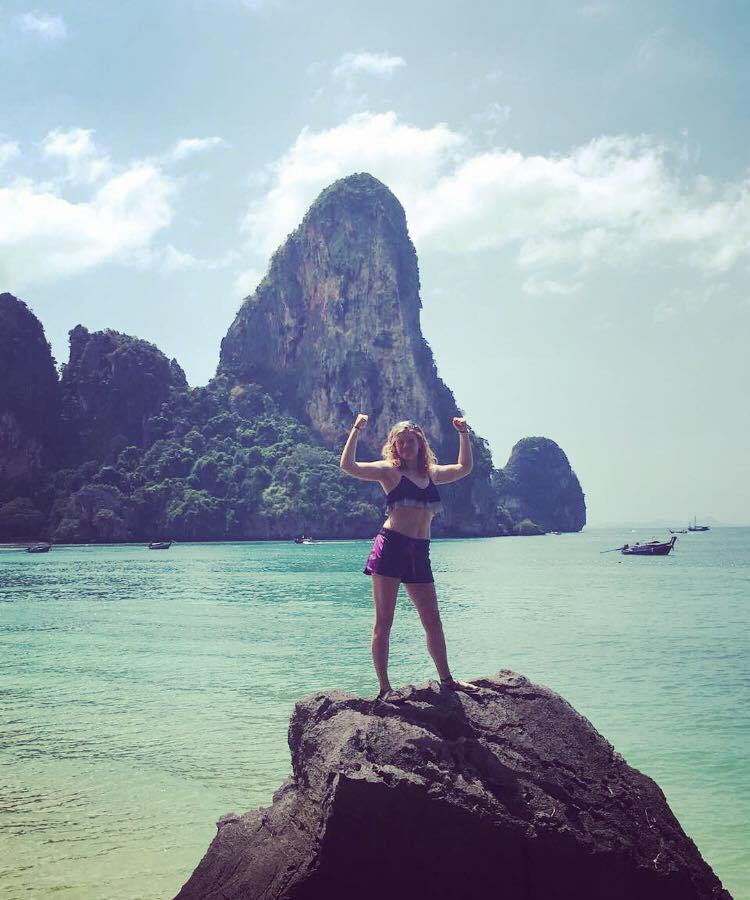
Let me introduce the author of this post, her name is Sara. I call her Honeybee. Not because its a cute pet name or anything. Because we met as counselors at a Nature Camp and we had to have Nature names. Don't ask me why. There was Bison, and Hedgehog and Blue Jay and Sprout and Honeybee....which one was me I hear you asking? None of them. I was Cockroach. Anyways, I have known Sara since she was like 16 and have seen her grow up to be a strong willed and adventurous young woman. She has spent the last while in Asia, traveling and teaching and generally being herself. I have no doubt that some of that time was spent trying to tame her hair, but to no avail. Sorry Sara, I couldn't help it. My most popular blog post ever was one I wrote about Women in Adventuring/Exploration and I wanted to follow that up with one that I know personally. Thanks Sara, for your input and for being someone that not only young girls/boys can aspire to be, but also because you inspire me. Because you're awesome. And I'm super jealous.

Love and Disaster in East Asia: 10 Lessons I Learned the Hard Way

Hi! My name is Sara and this is me.  I’m a directionless 23-year-old college grad who stumbled upon an opportunity to work and travel in Asia.  I have had great times and I have had terrible times, but most of the time, I am just trying to keep moving forward.  Thanks to Logan, I get to share some of my greatest successes (and a few epic fails) with you.  These are the 10 most important lessons, some of which I had to learn the hard way.

  1. IMG_20160222_145521[1].jpg
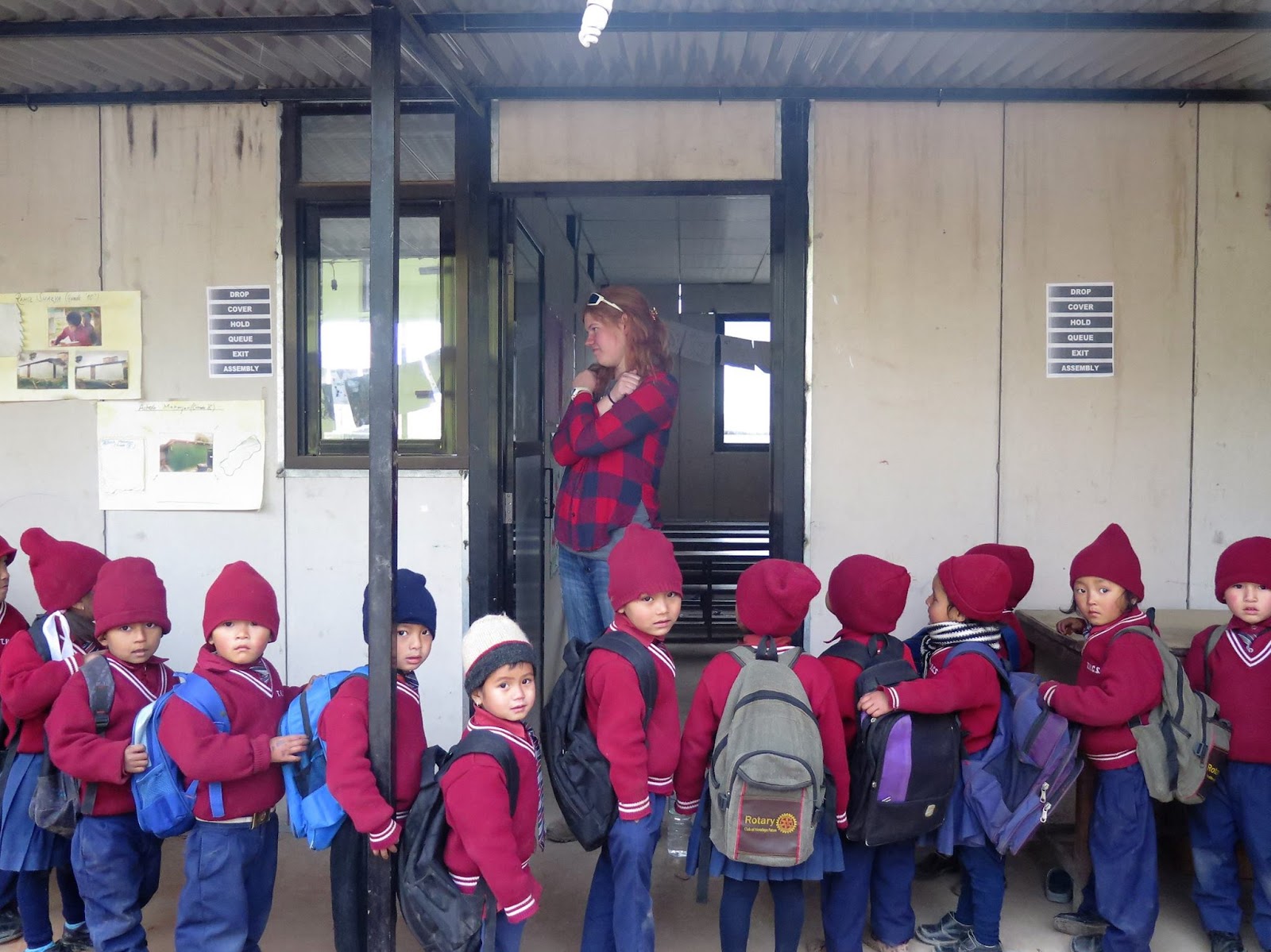
    If you are a native English speaker, count your blessings. No matter where I was, I was able to find at least 1 person with rudimentary English. I could buy what I needed and find my way when I got lost. In a farming village in east Nepal, I was even able to learn a handful of words and phrases in Nepali.  As an English teacher in China, I understand the popularity of the English language, but it wasn’t until Nepal that I really experienced how hungry people were for it.  A business that has the most rudimentary grasp of English has a huge advantage over one that doesn’t.
  2. Always do something that scares you. You might end up loving it. I went paragliding in Pokhara, Nepal. Me. Terrified of heights and, more specifically, falling from great heights. With nothing but a harness and glorified piece of fabric keeping me in the air (and also a pilot named Sabine to whom I entrusted my life). Despite the fog and smog, my view of the AnnaPurna range from 2000 m up was...surreal. There are only a few times in your life when you feel like you are finally big enough to stand out and face the universe in all of its vastness. In that moment, you realize just how small your footsteps are. You feel the thin threads of silky time tying you precariously to your present. You come face to face with your relative insignificance and it is the most liberating moment. You finally feel free enough to take the big risks that our collectively massive existence requires for growth.
CAM00652[1].jpg
  1. Pick up some local customs. In Nepal, the head movement for “yes” is bobbing your head from side-to-side instead of the western up-and-down.  The one-nod “hello” is universal, but you can also touch your hand to your heart or to your forehead (the third eye) instead of putting your hands in the prayer position when you say “Namaste” to someone. It’s these little things that make people treat you with a little more respect and less like a tourist.
  2. Don’t Panic. Ok, I’m borrowing this one from Douglas Adams Hitchhiker’s Guide to the Galaxy, but it’s true. There is a story I like to remember and it helped me through getting pickpocketed of all my money and important documents, on several small and cramped buses, and in long and confusing customs procedures.
A king once commanded his advisors to create something that would help him get through everything in his life. The highest of highs, the lowest of lows, this thing needed to be there to keep him grounded. After several months of debating, the advisors finally came to king. They presented him with a small gold ring with an inscription on the inside that read “This too shall pass.” Nepal has a similar motto: “We can manage.”  Both of these sayings serve as a reminder that our time is remarkably short and that happiness and success is something we create rather than happen upon. Freaking out in the middle of a crisis will not help anyone, especially you.  After the crisis is over, feel free to panic and cry. Personally, I recommended bad wine, good food, and great friends.
  1. I mentioned this briefly in the last lesson, but it needs it’s own section. Happiness and Success are things that we create, not find. On my travels, I met with a professional chef, several students, a virology lab tech, a few engineers, dozens and dozens of volunteers with varying backstories, international hospitality staff on seminars, managers and consultants of everything under the sun, and so many others who I didn’t have time to really know.  Many of these people were not Americans (which was an eye-opener for me in and of itself) and they were influenced differently to believe in more flexible measures of success. So often in Western culture (and particularly in the US), the daily grind lives up to its name because it only offers us 1 scale for success: the almighty dollar.  The backpackers and vacationers and workers I met did not share the same view. One night, in my hostel room, we held a yoga class led by a Chinese woman who had been practicing for only a year.  Between the laughs, falls, and broken English, we came to value this woman’s dedication, rewarding her with our thanks and respect.  For her, it was enough to simply share and communicate with us something that she considered important.
While travelling, your fellow bunkmates value you as much as you value yourself. If you think that your experiences are worthwhile and you gather the courage to share them, they will listen and discuss and inquire.  You have to create your own definition of success, see yourself as happy, and others will do the same.
  1. Research the things that are considered to be “Western luxuries” before you “go”. I mean this both figuratively and literally. Figuratively: In many places, even tourist towns like Bangkok and Siem Reap, free WiFi, hot water, electricity, and blankets may be hard to find. Literally: You want to know what else is hard to find? Tampons and toilet paper. See what I did there?
  2. It’s OK to relax.  You might be thinking, “But I’m on vacation, how much more relaxed can I get?”. Imagine you only have 2 weeks in an area that is famous for its temples and palaces and beaches and sights.  Of course you want to go see everything, so your day might look like this:

8:00
Breakfast
9:30
Great Wall at Mutianyu
12:00
Lunch
1:30
Summer Palace
4:00
Tiananmen Square
4:45
Wangfujing
5:15
Beijing Duck Dinner
8:30
Acrobatics Show and Fireworks
10:30
Bed

This. Is. Exhausting. And the next day isn’t any better because there are 4 more temples and 2 ancient markets to get to.  And pretty soon, “vacation” becomes “dragging your sore and sorry ass from one sight to the next”.  It all looks the same.  Nothing is exciting any more.  The only thing you can really hope for is that your fake smiles and clever hashtags get you a few more followers on Instagram to make up for your current fatigue.  Take a break.  Watch movies. Fight jetlag. Go to a coffee shop and sit there for 3 hours ordering cloyingly sweet lattes, the true flavor of victory in an Eastern tea-centric culture.  I promise, the temples will be there tomorrow.
On a completely unrelated note: Whoops! My bad! Sorry, Mom and Dad! #hangry
IMG_20160224_205813[1].jpg
  1. This is less of traveler’s lesson and more of a life lesson: Never try to out-drink an Australian. You will lose. Badly. I had the lake-soaked dress clothes and rolled ankle prove it.
  2. Take carry-on baggage only. Most of the time, airport security won’t lose your stuff.  Most of the time, if the small, low-cost airline won’t transfer your bags for you, you will have enough time to get your bags and re-check in.  But it is a huge relief that, when things do go wrong (I’m looking at you, Calcutta airport), you don’t have to hold up the plane even longer because you have to go and get a checked bag.  You can wash your clothes in any country you are in, either by hand or paid service.  You can buy any liquid toiletries anywhere including, to my delight and surprise, contact solution. You can leave your L’Oreal at home because travelers all look the same: worn and weary.  It’s a very noble look, even if the smell is a little funny.
OK, brief story about Calcutta: so basically you need an Indian visa to fly through this airport which, if you think about it, is really stupid.  Why would I need a visa to a country I don’t even want to enter?  I just wanted to pass through.  So after 30 minutes of being directed to 4 different visa lines, some older boss lady comes up and starts yelling “Where were you?”, “You are late!”, and “I was waiting for you!”.  I’m just standing there thinking, please, just take my passport and give me my plane ticket. I just want to leave. So she takes my passport and credit card info and e-ticket and walks away for another 40 minutes.  Then a different guy shows up with all of my documents and we walk in a short circle like he’s confused on where to go.  They call a guard who escorts us to a closed section of the airport where I get my own VIP security procedure.  They rush me to the gate and I finally manage to get on the plane just as it’s supposed to leave.  It would have been funny if I wasn’t so worried about missing my plane.
  1. Keep a journal. I would not have been able to write this if I hadn’t kept mine.  There are so many little things you forget when you are completely overwhelmed by the new sounds and smells.  The leaf-gold temples standing high above the city burn brightly in your memory and almost make you forget sipping your first Thai iced tea while watching the sun set over the river.The colossal majesty of Angkor Wat eclipses the innocent humor of a little girl riding to school on a bicycle that is much too big for her. The name of our resident elephant in Chitwan National Park (Pumaya), the Irish Red Cross volunteer leaping up to join the Tharu cultural dance program, making milk tea in a little farming co-op with Muna and her boys, Mohit and Marbin. My journal honors my time in these sacred places by providing me with the space to store those memories.  It honors the people I lived with, traveled with, or just talked with for teaching me something new about the world.  It lets me continue learning from these people long after they’ve gone by reading through the pen-captured conversations I can only barely recall. And best, it provides a teaching guide so that I can share the lessons I’ve learned with my family, my friends, and other adventurers seeking to start a journey of their own.

Monday, February 1, 2016

Far too Long...

While I have known this for a long time, recently my feelings have come to a head and its time to get them out. Indeed, its been far too long since I've written in this blog. Since the last time I did this, a lot has gone on in my life. So much so, that my entire outlook on what it means to be an explorer and an adventurer. Beware, this might get a tad preachy, but that is by no means my intent.

The past year I have managed to travel all the way across the country and back. I met some of the most amazing people at a far away place called Chestnut Lake. I also managed to survive a long stint in the midst of our Nation's Capital. For a boy that grew up under the wide open Nebraska sky, not seeing the horizon on a daily basis really drained me. That, and the twice daily bout of motion sickness from my metro ride to the State Department where I worked. I road tripped back across the country to New Mexico with my father, survived an earthquake in Oklahoma and actually found myself saying that Texas did indeed have some pretty country. I have also just started my student teaching and am currently in love with my Junior High students. Well...most of them. No matter how great the rest of them are, there are always going to be shitty teenagers. And now that I am back, I have been trying my best to stay in touch with the people that matter to me. I have rekindled at least one old friendship. My imagination is now running at full blast and I find inspiration every day.

What does this have to do with adventure and exploration? Its all part of life, man! Maybe its finally seeing a beginning of the rest of my life not so far off, or maybe its part of finally coming to terms with who I am. But I am finally coming to realize that the adventure and discovery doesn't just come from treasuring hunting, lost ruins and haunted caverns (although its definitely part of it). It is every where in life. My aunt was right, even my daily routine in 8th Grade Social Studies is an adventure (Thanks Pat!). Suddenly I see a future. It probably won't be what I imagine it to be, no matter how bad I want it. But maybe that will make it better still. In the mean time, I will do what I can to leave my mark for the better in this world. I will love who I love and treat my life as the adventure that it is meant to be. So many times, I have been asked, "why do you get up in the morning?" I usually answer, "why not?" Now, I can truly say that I wake up in the morning because I can't wait to see what happens next. That's the real adventure.

Enough of the mushy, feely stuff. Get out there and explore!

Friday, February 7, 2014

Cabin Fever, or "A Winter's Tale"


     As my fellow Mid-westerners know all too well, it is the dead of winter. In fact, we have a recent wave of frigid cold and layers of snow that dwarf any from earlier in the season. This generally puts a damper on the outdoor adventures. It isn't so much the cold or frozen snow that keeps me inside. Its other people. It seems to me that during the warmer months the majority of people completely forget how to drive n snow and ice. Far more dangerous than the freezing temps and blistering wind are the people who drive atop layers of frozen water as though it were normal road surface. This make for a nerve wracking, tiresome slog to the nearest trail head, all of which I am intimately familiar with. I have recently returned from a long stint of work in New Mexico where I spent every day exploring the high plains. It has been a rough couple months since then, readjusting to a mundane life and erratic work schedule. It doesn't help that when I get the time, the weather is at its worst.So how do I get my fix during these hard times?
DestinationTruthLogo.jpg     Recently I have rediscovered a show on Netflix that I adored as a teenager, Destination Truth. The premise is that a group of people, led by intrepid adventurer Joshua Gates, travel the globe in search of the truth behind mysteries and legends. A lot of people scoff at the fact that people still believe and search for things a kin to big foot. I will tell you that I a firm believer that there are things in the world that we have yet to discover. In this technological world we have created, it is easy to fall into the misconception that we have found all there is to find in the world.  With Google Maps able to give us a birds eye view of nearly everywhere in the world we can forget that places exist that have yet to be explored. While the Amazon Rainforest is rapidly shrinking, there a vast tracts that are untouched, the Himalayas, the Congo, even parts of Canada are unexplored. While the cast of Desitnation Truth never truly finds "the thing", some of the episodes do bring to light some unexplainable evidence.
      Watching the explorers jump from Brazil to Zambia to Vietnam definitely helps ease the wanderlust that is tugging at my heart. It also causes a tinge of jealousy to rise in my heart. I would really like to know how these people get approached to do these kinds of shows! I am more than willing to uproot everything and globe trot, to anyone who might be reading! Travel shows like the one I mentioned also give a nice, quick view of the far off places that the world has to offer. Did you know that there is a lake in the Congo the size of Connecticut? Me neither, till this morning. I also really enjoy watching the interactions of people from the United States and say...the Nepalese. The meeting of two different cultures is fun to watch, but some can be quite agitating. I am not usually one to sit in front of the tube and watch TV shows, but with little else to do it is nice to see a little bit of the world and learn something at the same time.
     Fortunately for me, spring is upon us and soon I will back at my summer job where I will be outside every day. Then as fall rolls around, I will be taking off to a new destination for Graduate School and a new place to explore will be at hand. Right now I am sitting and looking out the window and dreaming of fish by the lake, scuba diving and hiking...ugh....spring you could not come sooner...

Thursday, September 26, 2013

Bury Me Not on the Lone Prairie...

     As many of you know, I have been hired as a field surveyor on an archaeological project in New Mexico. This is my first job as a professional archaeologist and is quite exciting. I have already done one 8 day session but unfortunately I did not bring my computer nor my camera. I can assure you that it was a fantastic first week on the job despite the nearly constant presence of rain. We are surveying ground for a windmill farm that is taking us across a multitude of ranch land in central New Mexico. The majority of our findings are depression era relics however we have also found many stone tools from wandering Native Americans. Today was a particularly exciting day; firstly because I brought my camera and secondly because we found a site that told a story. I am going to share that story with you now.


     In the early 1900's the railroads passed through and bought up all the land alongside the tracks. Eventually this land was sold to people all over the country, but mostly back east with the promise that the land would be fertile for years to come. Many of these men and women took to growing beans; think pinto, not soy. This worked fine for awhile, however the elevation of the area keeps the annual rainfall fairly low and eventually the farmland was drying up. Then comes the Dust Bowl and Great Depression. These hard times cause many people to drop everything and leave, some head back east, others west as migrant workers. The remnants of this era are scattered about the empty short grass prairie.
     My day started out relatively normal as far as survey goes. We drove our truck down some lonely dirt roads that snake between large tracts of grassland. We parked, we got out, we line up and then marched in lines. For the first hour or so we found nothing, which seems to be the norm out here. A herd of female Pronghorns trotted by and a very short distance, followed closely by two ever watchful males. Shortly after we met the owner of the property who has lived on this land all his life; we all guess he was pushing his 80's. His father moved out here and bought the land in 1913 and started out as a bean farmer but turned to cattle when the farming looked bleak. This is one of the few families the survived through the Dust Bowl.
Remains of Model T
1930's wheel well/running board
     In another 45 minutes of walking we began to see scatterings of objects on our transects. The first being an old trash pile with the remains of a Model T Ford as its center piece. Later we found the wheel well and running board of a 1930's style luxury car. Atop the next hill appears to be some kind of structure that our boss guesses is the homestead to which the trash belongs to. As we get close the debris become more frequent. We start seeing old fruit or meat cans, Prince Albert tobacco and shattered glass jars. Upon finally reaching the top of the long rolling hill we come upon the place where someone once tried to make a home.
    The bodies of two old farm trucks; one a Ford, the other likely a Chevy, sit rusting away. A well
sits unused, still filled with water, and a scattering of large stones and a deep depression marks where

the dugout that the family lived in once stood. Among the artifacts that we found were broken china with intricate flower patterns, broken wine bottles, cosmetic jars, a belt buckle, a marble, various tools. Now I love the mystery found in a scattering of prehistoric pottery and flaked stone, but those kinds of artifacts leave behind a lot of guess work. Here we had a story of people who tried to make a living in a far away place and failed. These people are likely remembered by someone, their records left behind in a census or bill of sale or some such thing. This makes the site more personal and easier to access in a number of ways. This isn't the only sign of the tragedies of the Dust Bowl, not but 3 miles away is another abandoned farmstead. These are the sad, lonely reminders of one of the worst hard times in
Remains of Dugout House
American History.


Here are some other pictures from the day...


Sunday, March 31, 2013

Explorer of the Month: Fish Tales

     So I have been itching for spring to get here so it can finally warm up and I can start fishing. In honor of the arrival of my excitement for fishing I am nominating my favorite fisherman for Explorer of the Month. Fishing isn't usually the first thing that pops into mind when one thinks of exploring. I admit that it wasn't on my radar either until one man convinced me. His name is Jeremy Wade, host of the Animal Planet program River Monsters. Mr. Wade is a biologist by trade, but is also a renown "extreme angler". On his TV show he travels the world in search of over sized fish that may explain local legends and lore about man eating monsters in the the world's river systems. It is not only the travel to exotic, or some times rather mundane locales that makes him an explorer. Just by viewing the show, one can tell that Wade has the utmost interest in not only his quarry, but the stories and people involved.
     One of the most intriguing episodes takes place in Africa where he is fishing for the Goliath Tiger Fish. During this particular adventure, he becomes involved with a local tribe, learns about fishing gangs, hears a story about marauding hippos and handles some of mankind's very first fishing implements. If that does scream exploring, I don't know what does.
    Recently, I had the joy of reading his book "River Monsters: True Stories of the Ones that Didn't get Away". While at first glance, the book appears to simply be a rehash of the first couple seasons of the show. However, the stories he tells are filled with interesting asides and misadventures that Mr. Wade has gone through from his time as a young hopeful obsessed with fishing to the man he is today. We are talking plane crashes, encounters with Natives, and being arrested for espionage. These are things, that while mentioned on the show, are retold in great detail that makes the book interesting on many levels.
     It obvious from the words on the pages that Jeremy Wade had a deep caring for the these giants "monsters" and greatly laments that they are disappearing from the planet and that he may in fact be one of the last people to witness some of these giants. Jeremy Wade is a man, while I do not know him personally, that I look up to. His genuine interest in the world around him and the people within it alone makes him worthy of Explorer of the Month. If you haven't seen the show check it out on Amazon Instant Video, all of the seasons are free to stream with Amazon Prime. Also the book is a great buy for those interested in biology, fishing, or travel writing. It is complete with full color photos of some of his most awesome catches and adventures.

 www.amazon.com/s/ref=nb_sb_ss_i_4_13?url=search-alias%3Daps&field-keywords=river+monsters+book&sprefix=river+monster%2Caps%2C341

P.S. Sorry I haven't been posting much content, my very last undergraduate semester is finally coming to a close and I have been quite busy. However, I have several items in the works as well as some guest writers. Stay tuned and hang in there with me! Thanks guys!

Thursday, February 28, 2013

The Longest Hajj: Explorer of the Month


     It is thankfully the last day of February and Spring is right around the corner. It has also been a full 28 days and I have yet to post an Explorer of the Month. Never fear.

http://eventsandpromo.info/wp-content/uploads/2010/08/ibn_battuta_07.jpg
 Ibn Battuta, brought to you by Ibn Battua Mall in Dubai.
    I love the so called "New World". I love mountain men, and cowboys and treasure hunters and Conquistadors and natives and all of that New Worldy stuff. However, there is much more to the world than that and I decided I should talk about that as well. Not that I don't love it as well, it just isn't my specialty. So that brings me to the Explorer for this month. He is a man that traveled many thousands of miles during his life time and saw more people, places and things in his journeys than many explorers of European descent. Yet he still remains obscure to many. His name was Abu Abdullah Muhammad Ibn Abdullah Al Lawati Al Tanji Ibn Battuta. Doesn't ring a bell? Perhaps you know him simply as Ibn Battuta.
    Ibn Battuta was born into a family of Islamic scholars in Tangier, Morocco (making him a Tangerine!) on the 25th of February of 1304. At the age of 21, Ibn dropped everything and left his home, family and friends behind in order to complete his Hajj, or pilgrimage to Mecca. This feet would take him sixteen months to complete but he would not return to his home for 24 more years. His travels would take him across nearly every corner of of the Old World.
http://24.media.tumblr.com/tumblr_mapivjhzz61rcl4bvo1_500.gif
Believe it or not, this map is courtesy of "Fuck Yeah Cartography!", Google it.


     As you can see from the map, this guy went a lot of places. He saw parts of Africa, Europe, Arabia, India, Indonesia and china. It no wonder that his trip took as long as it did. Ibn Battuta made his way to Mecca by way of Syria, he would stop in Medina to visit the tomb of Muhammad. On his way he visited many holy sites including Jerusalem and Bethlehem as well as the great port city of Alexandria. Upon reaching his destination he decided he would keep on walking in order to see the extent of the Muslim Empire. All along the road he wrote about everything he saw and compiled an autobiographical text about his journey, known today as the Rhila. His next destination was a Mongol Khanate called Ilkhanate that was centered in Persia. This is merely the beginning of his epic journey to see the world, which is the one thing he desired the most. After ending his wanderings he relayed all of his quest to a scholar named Ibn Juzzay, to whom he said "I have indeed - praise be to God - attained my desire in this world, which was to travel through the Earth, and I have attained this honour, which no ordinary person has attained." I could go on and on about what he did and saw and where Ibn Battuta went. However, I merely would like to wet your appetite for knowledge and hopefully you will take it upon yourself to learn more about this great man. I here by deem Ibn Battuta as the Explorer of the month for February 2013, 708 years and three days after his birthday. I do so on the grounds that he was a man who wanted only to see the world and to learn from what he found. I can think of no better definition of an explorer than that.

There are a ton of books about Ibn Battuta and his travels; here is a link to Amazon.com that will provide a good jumping off point for those interested.

http://www.amazon.com/s/ref=nb_sb_ss_i_0_5?url=search-alias%3Dstripbooks&field-keywords=ibn+battuta&sprefix=Ibn+B%2Cstripbooks%2C142&rh=n%3A283155%2Ck%3Aibn+battuta

Monday, February 18, 2013

What Lies Beneath, or "I'm Telling you...It was THIS BIG!"

     Ever since I was a kid, I loved the water. I loved swimming and if you ask my parents I loved taking loooooong showers. Heck, I even had a bedroom decorated entirely with underwater life. There were many times I remember being referred to as being part fish. The state I grew up in has a good quality game and parks program and a number of nearby streams, lakes, ponds and rivers to drop a line into. As a child I never went fishing a lot, occasionally I went with my dad, friends or on a Boy Scout camping trip (proud recipient of the Fishing Merit Badge). However, this never really amounted to very much in the way of a fishing passion. I do remember that I always had a keen curiosity for what was underneath the waves. At one point, my roving grandparents lived in a small town in Missouri that was near a series of large lakes. On one particular visit we went to a restaurant on a bank high above the water. This joint specialized in catfish and they had a tank full of some of the fattest catfish I had ever seen. Of course that may have partially been due to my minute stature as a kid. I think perhaps ever since that day, catfish have been my favorite under water curiosity, both to look at and eat. Attached to the restaurant was a long suspension bridge that dangled above the narrowing water below. My mother, who was afraid of heights mind you, took me out to the middle and we looked down below at the churning brown waves. What was down there?
    During my teen and pre-teen years, my parents had taken me to Mexico (partially the reason I turned to archaeology) and Spain. I like to say that mother has this disease where she thinks she is part Mexican. The symptoms include a fascination with all things Spanish, be them from Spain or Mexico or elsewhere. She probably has like...stage 3 chronic onset or something, as displayed by the mixture of pseudo Hispanic decorations all over our house. Anyway, this brought me close to the ocean of more than one occasion. The ocean to me was always kind of scary. Not like the run away and hide scary, but scary none the less. It was large, and who knows what lie in the vast abyss beneath the wind tossed waves? Multiple readings of "The Shadow Over Innsmouth" and other Lovecraft stories only fueled this feeling and curiosity. It was not only the ocean that gave me a macabre since of wonder. On a trip down to Cancun, my parents took me to a massive sink hole where the guide told us that the Maya had thrown in sacrificial victims. The water was a deep sapphire and two tourists swam in the eerie gloom. All I could think of was the hundreds of bones and relics that lie in a heap deep beneath the crisp surface in the unwavering black.
     Over time I continued to fuel my untapped passion for the water by various means. A particular video game, titled "Endless Ocean", was the only reason I even bought a Nintendo Wii. I savored the experience of scuba diving among all sorts of strange and beautiful life, even if it was just an educational video game. I discovered another quirky game about fishing and then low and behold I saw and advertisement on Animal Planet for a new series. River Monsters with Jeremy Wade. Wade is an "extreme angler" and biologist that hunts down the the subjects of the worlds greatest "Fish Tales". I ate this show up, from giant catfish to freshwater sharks and massive rays. Oh the marvels that lurked on the river beds of the world. My father, just over one year ago, graced my presence with a fantastic book by Jeremy Wade himself and this prompted me to buy my first, very own fishing pole! I was giddy. I by no means hopped to catch a giant carp or man eating catfish like Mr. Wade but I now had a chance to explore what was under the water on my own. I spent many afternoons on the rocky shore of a nearby lake during the hot summer. I only managed to catch a few Bluegill and Sunfish but I loved every second of it. The waiting, the sweat from the sun, the tug of war between the fish and I, and finally seeing the creature that I had struggled with before I let it return to its watery home,  it was all exhilarating.
    The waters of the world are an important resource, both for survival and to feed human wonderment. There is so little of the ocean that has been explored; the ocean is teaming with life yet unseen. Even the channels and waterways that are so close to home can hold mysteries and legends just waiting to be uncovered. These habitats are also is danger. Pollution, tourism and commercial overfishing are ruining the world's oceans and freshwater. There is a Star Trek movie that involves the consequences of whales going extinct. And while I have little hope a giant alien vessel will come and punish us for ruining the environment, that is still not a world I would like to live in.
    This is my last semester of college (finally, I know!), and I have been trying to come up with projects or pursuits that will fuel my thirst for adventure and for writing. Over the summer I will be posting some of my adventures in fishing and scuba diving as I plan to take classes in my spare time. I guess the point of this particular post is to show that their are many ways of exploring. Hiking, climbing, star gazing, fishing; all different ways to experience our wonderful world/universe and all that it has in store for us.

For those of you who are interested in learning more about your home state's fishing programs, check your local Park and Recreation website. For those of you in my home state, you are in luck! I'll provide the links!

http://outdoornebraska.ne.gov/fishing.asp
http://outdoornebraska.ne.gov/fishing/programs/aquaticed/aquarium.asp (a really nice local aquarium)