Showing posts with label prehistory. Show all posts

Monday, July 4, 2016

The More Things Change The More They Stay The Same..., or "Today's Lesson"


Good afternoon class. If we haven't met before, my name is Mr. Whitney. That's right, like the girl's name. Get your laughs out now. Before we begin, I want to know something, have any of you ever read any James Michener? No. Well I don't blame you. Today we are going to do a "reverse Michener". Instead of starting way back in time and building up to now, we are going to tear down the present and end up back at the end of the Ice Age. Sounds cool, right? Hey! Quit your groaning in the back, Kristina! Make sure you're paying attention, this will be on the test.....

   Okay, so now that the formalities are out of the way let's start with a little town called Fairbank, aptly named as it sits on a nice little spot along the banks of the San Pedro river in Southern Arizona. No one lives there anymore. It's a ghost town. Once it was a nice little mining town near Tombstone, famous for Wyatt Earp and the Clanton feud. Ike Clanton himself had a ranch nearby little Fairbank but that's another story. So here we are in 2016 and all that is left of Fairbank are some little wooden buildings, a cemetery, a rebuilt school house and the ruins of a large Silver Stamping mill. The school house was restored in 2007 and also houses a modest library and gift shop for visitors. It is maintained as a historic site by the Bureau of Land Management as part of the San Pedro Riparian Area. If you happen to visit, I highly suggest you see if Ron Stewart is the volunteer for the day. He is super nice and very knowledgeable. What's left of this little town is tucked away along a lonely stretch of highway between Whetstone and Tombstone, the buildings are huddled together beneath the shade of Cottonwoods and the humidity of the river.
The Fairbank Silver Mill
     Just under a mile away is a small cemetery, run down and decrepit. The perfect place to either bury a treasure or be haunted by an old cowboy's ghost. Your choice. The hill has been eroding for nearly a century since the last person was buried there, the wooden crosses have dry rotted and the stones that keep the dead in their tombs have began to migrate to greener pastures. Even further down the trail are the megalithic remains of an old Silver Mill. Here, the gravity of falling water generated enough steam and energy to forcefully move metal rods up and down, up an down, again and again, essentially grinding raw silver ore into dust. Now, all that's left are giant walls of mortared stone, a lasting testament to both man's ingenuity and greed.
     The real question is why do you think this town sprung up here? Anybody? *chirp chirp*. You, the blonde in the back with Doctor Who shirt. Yes you. What do you think? Very good! It's the river. The river is why they chose to build. As mentioned before, this town relied heavily on its Silver Mill, which of course used the coursing water of the San Pedro to do its job. The Mill brings workers, workers bring their families and then a town pops up. The Railroad comes to ship the goods and soon enough you have a hotel, a mercantile and schoolhouse. But eventually the rails decide to move elsewhere, the people run out of things to do and they all move on. It's the story of more little towns than one can probably count. At one point, the U.S. census states that there were a whopping 72 people living in Fairbank. A little strange because the Business Directory lists at least 242 in 40 households. During this time, the Census was not something to be trusted. Many people considered it government over reach and some just plain didn't want to be found. Fairbank was never very big by any means, Tombstone being only a 15 minute drive away, but it had its place in the web of the mining economy in Southern Arizona.
    Speaking of Tombstone, let me deviate for a second for a pretty cool story. Don't roll your eyes at me Mr. French. Wyatt Earp. Famous and/or notorious gunfighter of the Old West. Made popular by his shootout with the Clanton gang at the O.K. Corral in Tombstone, Arizona, was once tried for murder. Many thought that he wrongfully killed those men cold in the street, many had a less than positive perception of the man. They charged him with murder. Fearing that he would not get a fair trial in Tombstone, the judge had his trial moved to Fairbank. After news spread of Wyatt's charges, old acquaintances and friendly citizens of Dodge City, Kansas sent letters speaking highly of Earp's honor. Wyatt was eventually acquitted and the charges dropped. Prime example of how important it is to have a good reputation.
    Anyway, Fairbank was founded alongside the San Pedro because of the abundance of water. It lasted from 1881 to 1973. But what happened before? Any guesses? Susie, go ahead. There were Native Americans there? Well, you are not wrong, but there was something else in between. Ah, the Spanish. Awesome. So the Spanish had come to this area for the same reason. The land was rich and fertile because of the river valley. Fairbank was built within the boundaries of the San Juan Boquillas y Nogales Land Grant that was once owned and operated by the Elias family out of Sonora. They came into the land in 1823 and the Spanish intended to settle it as part of New Spain, or Mexico, by today's terms. They had a hard time of it because they weren't the only ones there. The Chiricahua Apache fought them every step of the way which led to the abandonment of the area, leaving nothing but thousands of wild cattle roaming the San Pedro River Valley. In 1854 this area became part of the United States after the Gadsden Purchase but wouldn't be settled until the founding of Tombstone, Charleston and Fairbank.
    So why were Spanish trying to ranch there? What made it good for such a thing? Andy? Very good, its the water. I think you are catching on to the pattern here.  The San Pedro River creates an area that is far more fertile than the surrounding Sonoran Desert. Water is a hot commodity in the desert and everything relies on it. Even today, the land around the river is filled with Cottonwood trees, Mesquite, marsh grasses and all kinds of wildlife that rely on the water found there. In 1695 Father Eusebio Kino visited a string of Apache villages just north of the ruins of Fairbank. 156 years earlier, in 1530, Fray Marcos de Niza explored the area for the King of Spain describing the area as "an irrigated, evergreen garden" (Friends of the San Pedro River). Again, its the water.
Prehistoric Pottery and Points
     Alright, one last thing, I promise. The time machine is going to start moving faster now. Before the miners, the Spanish and the Apache, there were others. The Hohokam, the Mogollon and the Salado cultures all had settlements alongside the San Pedro River. Before them was the Cochise Culture lasting from around 5000-200 BC. Before the Cochise still, we have the Clovis. Who can tell
me who the Clovis are? Red hair and glasses, in the front, what do you think? Perfect, the Clovis were one of the first major migrations into the Americas. This happened between 12-9,000 BC, give or take a few and low and behold, there they are right along the San Pedro River. Now the climate back then would have been much different from the desert that it is today, but regardless the water was very important. The San Pedro started flowing at the end the last Ice Age and would have attracted all kinds of animals including Megafauna. Near Fairbank is Murray Springs that has evidence of Mammoth and Bison Antiqus kills. Also along the River are the Naco and Lehrner Mammoth Kill sites, just a stone's throw away.
    Ah, a question Mr. Petro? What's the point of all this? Excellent, I was just getting to that. What have I told you again and again is the point of studying History? Not the names. Not the dates. History shows us the overarching themes of human interaction and existence. Now I know it seems obvious that people need water. Everything needs water. But today we have talked about some concrete examples of how people relied upon the San Pedro river for their lives and livelihoods. The river gave them game to hunt, grass to feed cattle, and power to run their mills. It brought food, settlers, miners, merchants, and families. This is a pattern that will ring true nearly everywhere in the world with only a few exceptions. Where there is water, you will find people. Even today, the San Pedro is a conservation area that attracts visitors and outdoor enthusiasts from all over. Ranches still dot the valley and other towns have sprung up. If you ever hope to understand people, history is where you need to begin. Thanks for paying attention today class...for the most part....except you Scott. I saw you sleeping over there. I'll see you after class. 


Saturday, June 25, 2016

Sing it from the Mountain Top, or "Too Far From the Beaten Path".


Top of the Mountain
   Since last time I wrote a post I have a lot of stuff go on in my life, all of it positive I might add, but still requiring a lot of thought processing. When I feel overwhelmed or stressed out, the best place for me is outdoors. I realize that there is a lot of talk about how the outdoors can help with things like depression and anxiety, and that might be true in some cases, but that is not true for everyone. But
Looking East from the Sandias
that's not necessarily what I am talking about. Being outside is like my meditation. Being surrounded by the Natural World refreshes sense of wonder and gives me some perspective. Its like meditation for me. Except I don't really know what that feels like because my mind wanders too much. But I can imagine there is a similarity. Maybe it's standing next to towering Ponderosa pines, hearing the wind blow through the the grass in a high mountain meadow, or making eye contact with a pair of deer as they nonchalantly pick their way through the brush; whatever it is, it brings me peace. As I mentioned before, big week for me. Lots to think about. Something in me decided to climb a mountain. So I did.
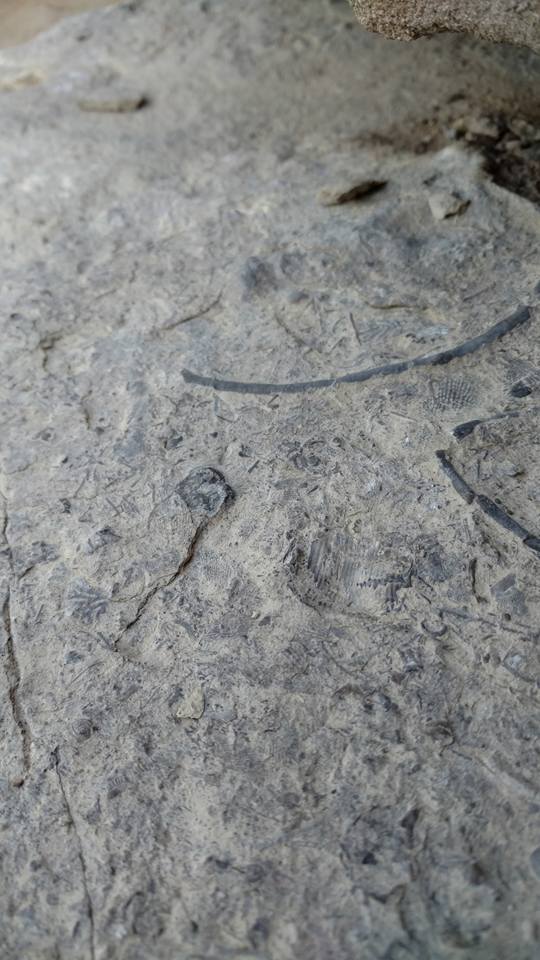
     I had been reading about interesting things in the area and read about an outcrop of limestone at the top the Sandias that supposedly had fossils. Nothing really special, mostly coral and small bivalves, but regardless, I wanted to see it. I could have driven to the top, parked, had a short, relaxing hike and been done. Did I do that? No. No I didn't. On a whim I parked just short of halfway up that bad boy and hiked. One of my favorite parts of hiking up a mountain is being able to go through all the different ecosystems that melt together as the elevation increases. The trail I chose began next to a small stream at the very top of Madera Canyon, it was a fairly modest trail, lacking in upkeep and only tenuously marked, making it all the more exciting. Looming above me, somewhere above the massive pines, was the peak that I sought to reach. The tail meandered up around the side the mountain, taking me through some truly beautiful stretches of forest. Unfortunately that was not the case the whole time.
     I spent a lot of time in my life working for a Nature Center in Nebraska where were basically in constant battle with Invasive Species. Sounds dramatic? Good. Because it was. Lost a lot of good
Prescribed burn back in NE
people out there. Stretches of the forest that I walked through were in really bad shape. Inches of duff (basically dead plant matter) covered the forest floor with barely any under story growth. In other places Scrub Oak blanketed the area in a near mono-culture. The mountain is in desperate need of a good burning. Fire was one of the most important aspects of managing our Prairie back home, and is also super important for keeping a healthy forest. I admit, I am not an expert in forest management and I realize there is a ton of planning an budgeting that goes into it. Problem is, unless you stay on top of it, the next time there is a fire it can be severe. Just a week or so ago, a large fire sprung up in the Manzano mountains southeast of Albuquerque. The Sandias are closer to an urban area and could potentially cause a greater loss of property and life if not contained in time. Thousands of years ago, lightening and mindful Native Americans made sure that fire did its part, whether it was intended or not. There are even a number of plants that will remain as seeds until fire coaxes them out. Fire is important, and it hurts my heart to see the forest in such bad shape.
Easiest way to read "Owls Hoot in the Daytime"
     Anyway, enough of the preaching. So I am about halfway to my destination and I stop to down some Powerade. What do I hear? An owl hoot in the daytime. First off, I freaking LOVE owls. Back at the nature center we had these two little screech owls and they were so cute and perched on my hand and then there was this blind Barn Owl and watching him eat was disgustingly fascinating. Second: "Owls Hoot in the Daytime" by Manly Wade Wellman is one of my favorite short stories ever! If you haven't had the chance to read it, find me and I will make sure you do. In the story, the owl calling out during the day signifies that the main character has traveled too far from the beaten
path. It is derived from old Appalachian folklore; I promptly ignored its warning and continued on.

     It was a long trek, not going to lie. I had to take a more than a few breathers because walking up hills is hard work. My eyes widened as I walked
Looking down from the top
into a wide open meadow very near the top. The top of the Sandias is a really popular hiking/trail running/dog walking area and I rapidly came to realize that I was not really in the wild anymore. My dreams of bear taming crushed for the day, I couldn't help but pick up some of the trash I came across in the trail to at least be placed in a trash can next time I saw it. I can forgive ill maintenance of the parkland, I get it, its hard, it costs money, and it can be really dangerous. You know what isn't any of those things? THROWING AWAY YOUR DAMN TRASH. Seriously. Put it where it belongs. Awesome, two preachy moments in one post.

      Anyway, eventually I made my way the highest point on the mountain and looked down and out across the world around me. Gods is it a beautiful sight. In moments like that, I am overwhelmed with a sense of place. That meditation thing I was talking about at the beginning. I knew where I was and for a moment my doubts and fears rushed away with wind. But I still had a goal. I had to find me some fossils. The age of the earth is profound to me. The fact that at the top of the mountain I am standing on what used to be the bottom of an ancient sea. Untold centuries of violent processes radically changed the shape of the surface into what I was seeing then. Talk about perspective. Looking out into the horizon, feeling the weight of time and pressing my hands against the remnants of some of the earliest lifeforms on the planet. People find solace in many things. Religion. Fantasy. Art. I find it most often in the feeling of insignificance. It is peaceful there. Maybe a bit lonely. But it's clarity. For me at least. I close my eyes and take a deep breath. I look up at the sky. Down at the world. Peace. The hike back down in way easier. I feel a little high. Maybe its the meditation, maybe its dehydration. Who knows. Aside from being stabbed in the side by a Yucca thorn, it was a good day.
Bottom of the Ocean


Thursday, September 26, 2013

Bury Me Not on the Lone Prairie...

     As many of you know, I have been hired as a field surveyor on an archaeological project in New Mexico. This is my first job as a professional archaeologist and is quite exciting. I have already done one 8 day session but unfortunately I did not bring my computer nor my camera. I can assure you that it was a fantastic first week on the job despite the nearly constant presence of rain. We are surveying ground for a windmill farm that is taking us across a multitude of ranch land in central New Mexico. The majority of our findings are depression era relics however we have also found many stone tools from wandering Native Americans. Today was a particularly exciting day; firstly because I brought my camera and secondly because we found a site that told a story. I am going to share that story with you now.


     In the early 1900's the railroads passed through and bought up all the land alongside the tracks. Eventually this land was sold to people all over the country, but mostly back east with the promise that the land would be fertile for years to come. Many of these men and women took to growing beans; think pinto, not soy. This worked fine for awhile, however the elevation of the area keeps the annual rainfall fairly low and eventually the farmland was drying up. Then comes the Dust Bowl and Great Depression. These hard times cause many people to drop everything and leave, some head back east, others west as migrant workers. The remnants of this era are scattered about the empty short grass prairie.
     My day started out relatively normal as far as survey goes. We drove our truck down some lonely dirt roads that snake between large tracts of grassland. We parked, we got out, we line up and then marched in lines. For the first hour or so we found nothing, which seems to be the norm out here. A herd of female Pronghorns trotted by and a very short distance, followed closely by two ever watchful males. Shortly after we met the owner of the property who has lived on this land all his life; we all guess he was pushing his 80's. His father moved out here and bought the land in 1913 and started out as a bean farmer but turned to cattle when the farming looked bleak. This is one of the few families the survived through the Dust Bowl.
Remains of Model T
1930's wheel well/running board
     In another 45 minutes of walking we began to see scatterings of objects on our transects. The first being an old trash pile with the remains of a Model T Ford as its center piece. Later we found the wheel well and running board of a 1930's style luxury car. Atop the next hill appears to be some kind of structure that our boss guesses is the homestead to which the trash belongs to. As we get close the debris become more frequent. We start seeing old fruit or meat cans, Prince Albert tobacco and shattered glass jars. Upon finally reaching the top of the long rolling hill we come upon the place where someone once tried to make a home.
    The bodies of two old farm trucks; one a Ford, the other likely a Chevy, sit rusting away. A well
sits unused, still filled with water, and a scattering of large stones and a deep depression marks where

the dugout that the family lived in once stood. Among the artifacts that we found were broken china with intricate flower patterns, broken wine bottles, cosmetic jars, a belt buckle, a marble, various tools. Now I love the mystery found in a scattering of prehistoric pottery and flaked stone, but those kinds of artifacts leave behind a lot of guess work. Here we had a story of people who tried to make a living in a far away place and failed. These people are likely remembered by someone, their records left behind in a census or bill of sale or some such thing. This makes the site more personal and easier to access in a number of ways. This isn't the only sign of the tragedies of the Dust Bowl, not but 3 miles away is another abandoned farmstead. These are the sad, lonely reminders of one of the worst hard times in
Remains of Dugout House
American History.


Here are some other pictures from the day...


Sunday, May 26, 2013

An Age Undreamed of....


     "Know, O Prince, that between the years when the oceans drank Atlantis and the gleaming cities, and the rise of the Sons of Aryas, there was an Age undreamed of, when shining kingdoms lay spread across the world like blue mantles beneath the stars..."
-Robert E. Howard

    About 5 years or so ago, I found myself far away from the home that I had known since my birth. I was lost, no friends, no job, living in my parents house in the desert. I did not like the person that I was and needed a change. One night, I was browsing through movie titles at the local rental place and came across the 1982 version of Conan the Barbarian. From my delving into pulp era literature I knew that the creator of Conan had been dear friends with my favorite author H. P. Lovecraft. I was not huge into fantasy but I picked it up, popped it in the DVD player and then my life had changed. A lot of people will laugh and wonder how a shirtless Arnold Schwarzenegger from the 80's change how I viewed the world, and isn't this a blog about exploration? I am getting to that, so hold your horses.
     Many people write off this film as testosterone driven fantasy, however they are sorely mistaken. This movie tells the story of how a boy becomes a man, how a man becomes a hero, and how, in the end pain and failure are learning tools. The film starts with a quote from Nietzsche, "That which does not kill us makes us stronger...". This is the film's major theme. Director John Milius (who also made Jeremiah Johnson),  uses the character and back drop of Robert E. Howard's pulp era fantasy to tell a Nietschean parable about becoming the best man you can be. It was simply me being in the right frame of mind, and willing to accept the lesson that the story was trying to tell. Along with the brilliant cast and masterwork score by Basil Poledouris, the movie is a cinematic masterpiece that many write off as cheesy and pure fluff without ever taking the time to think about what is on the screen.
    The movie drove me to seek adventure and meaning in the world, to push my limits and discover who I am. After all, isn't that one of the main reasons we explore our universe? To discover who we are, where we came from and what we are meant to be, as a species as well as an individual. This film also led me to the actual writings of Robert E. Howard, another facet in how a barbarian from a lost age changed my life for the better. I bought the Del Rey edition of "The Conquering Sword of Conan" shortly after I had watched the film. For any who have both seen the movie and read the short stories, you already know the difference. For those of you who haven't, the 1982 Conan is the barbarian in name only. Robert E. Howard wrote of a man of the wilds, head strong, intelligent, intellectual and daring. He roved seas, traversed mountains and jungles, was a thief, a pirate, a general and the best king to have ever taken the Aquilonian throne.
     These were stories of adventure, something I so desperately needed in my life. Conan saw places and things that those of the civilized world only dreamed of. That is what I yearned to do. This is how my love for adventure and exploration was born. It is kind of funny how some things can be so meaningful to some. There are many lessons to take from both the movie and the stories and I highly suggest to any who love adventure to seek these out and find out for yourself the greatness of Robert E. Howard and Conan. Perhaps they will inspire you to seek out the dark corners of the Earth and
unseen places like it has myself.

Pict Attack, for the book The Conquering Sword of Conan, 2004, oil on linen, 20 x 16.
http://www.amazon.com/Coming-Conan-Cimmerian-Original-Adventures/dp/0345461517
http://www.imdb.com/title/tt0082198/?ref_=sr_3
www.conan.com

Sunday, March 31, 2013

Explorer of the Month: Fish Tales

     So I have been itching for spring to get here so it can finally warm up and I can start fishing. In honor of the arrival of my excitement for fishing I am nominating my favorite fisherman for Explorer of the Month. Fishing isn't usually the first thing that pops into mind when one thinks of exploring. I admit that it wasn't on my radar either until one man convinced me. His name is Jeremy Wade, host of the Animal Planet program River Monsters. Mr. Wade is a biologist by trade, but is also a renown "extreme angler". On his TV show he travels the world in search of over sized fish that may explain local legends and lore about man eating monsters in the the world's river systems. It is not only the travel to exotic, or some times rather mundane locales that makes him an explorer. Just by viewing the show, one can tell that Wade has the utmost interest in not only his quarry, but the stories and people involved.
     One of the most intriguing episodes takes place in Africa where he is fishing for the Goliath Tiger Fish. During this particular adventure, he becomes involved with a local tribe, learns about fishing gangs, hears a story about marauding hippos and handles some of mankind's very first fishing implements. If that does scream exploring, I don't know what does.
    Recently, I had the joy of reading his book "River Monsters: True Stories of the Ones that Didn't get Away". While at first glance, the book appears to simply be a rehash of the first couple seasons of the show. However, the stories he tells are filled with interesting asides and misadventures that Mr. Wade has gone through from his time as a young hopeful obsessed with fishing to the man he is today. We are talking plane crashes, encounters with Natives, and being arrested for espionage. These are things, that while mentioned on the show, are retold in great detail that makes the book interesting on many levels.
     It obvious from the words on the pages that Jeremy Wade had a deep caring for the these giants "monsters" and greatly laments that they are disappearing from the planet and that he may in fact be one of the last people to witness some of these giants. Jeremy Wade is a man, while I do not know him personally, that I look up to. His genuine interest in the world around him and the people within it alone makes him worthy of Explorer of the Month. If you haven't seen the show check it out on Amazon Instant Video, all of the seasons are free to stream with Amazon Prime. Also the book is a great buy for those interested in biology, fishing, or travel writing. It is complete with full color photos of some of his most awesome catches and adventures.

 www.amazon.com/s/ref=nb_sb_ss_i_4_13?url=search-alias%3Daps&field-keywords=river+monsters+book&sprefix=river+monster%2Caps%2C341

P.S. Sorry I haven't been posting much content, my very last undergraduate semester is finally coming to a close and I have been quite busy. However, I have several items in the works as well as some guest writers. Stay tuned and hang in there with me! Thanks guys!

Thursday, January 31, 2013

Explorer of the Month: Douglas Preston

     While wandering up and down the musty smelling aisles of the local public libraries I have passed a certain book more than a few times. I love to read very much but am a heinously slow reader so no matter how much my curiosity was spiked I always passed this particular volume by. The tome is thick, somewhere around 400 pages tiny printed text, bound in a large hardcover with a water color painting of Coronado scrawled of the front. The book jacket is yellowing clear plastic and with the library bar code placed in the upper left corner. This particular book is titled "Cities of Gold" and is written by this months Explorer, Douglas Preston. Douglas Preston is an author from Cambridge, Massachusetts and is a bestselling author of both fiction and non fiction. He got his writing career off to a start when writing for the American Museum of Natural History in New York. He wrote his first book, Dinosaurs in the Attic, in 1986 and continues to write today.
   Having lived and fell in love with the deserts of the southwest I was drawn to "Cities of Gold" simply by title alone. I did not really know what to expect from the book but upon my completion of the book what I found is quite possibly the greatest nonfiction story I have ever read. Mr. Preston, once a product of the city and described as a Yankee by many people throughout his book, decided to move to New Mexico on a whim. Eventually he decides that he will trace the trail of Francisco Vasquez de Coronado through the American Southwest; from the Mexican border, through Arizona, and up to Santa Fe. For Coronado and his men, this was an excruciating, arduous trek that led them across most of the American continent. For Preston and his companions this would prove to be just as difficult as the original search for the seven cities of gold.
     The quest of Douglas Preston and his companions I feel was many things, one was the search for what it means to be American which I feel is a very important question for those of us from this country. Another reason for this journey was to simply prove that they could do it. Throughout the book Preston often expressed frustration when people told him that we was just a "Yankee" and would probably die along the way. The writing of this particular book really conveyed the sense of wonder, danger and awe that he must have felt as he traveled through the desert southwest. One of the most compelling parts of this book are the interactions with the myriad of people that he met along the way. Preston also conveys a deep sense of respect for the land and its people, especially the natives that lived there before us. There is a stark contrast between the "once was" and the "is now" and it is very interesting to see the changes and how rapidly they came. I have literally only glanced over what is contained between the covers of this book. I do need to say that after completing it I was brought to tears by the shear beauty and poignancy of this "Cities of Gold". I am probably not considered an expert on literature, but I feel as though this is one of the most important books I have read.
    Enough about the book, I need to say a little as to why Douglas Preston has earned this Explorer of the month award! Firstly, it is well known that Coronado did not have an easy time with his journey, scholars are not even sure of the exact route. Having the courage and the grit to take up the challenge of following in the footsteps of one of the great conquistadors is merit enough. Secondly, he has not only done this once but continued to seek adventure throughout the world by following other historic trails on horseback. Very soon I will be reading a follow up book of sorts about another one of his adventures. I will be sure to post my thoughts on what I am sure will be another excellent read. I think most of all I appreciate Mr. Preston's ability to leave everything behind and pursue something different, something of the beaten path. That is what has earned Douglas Preston my explorer of the month award for February of 2013.

Here is a link to Preston and his partner's website: http://www.prestonchild.com/

Here is a link to the Douglas Preston Amazon page: http://www.amazon.com/Douglas-Preston/e/B000AQ0AWW

Sunday, December 16, 2012

A Walk Beneath the Long Dead Sea: or "My Trip to the Badlands of South Dakota" Part 3

     Following the series of stone monuments that had been left for travelers like me, I made my way through the tall emerald grass accented with the brilliant whites, yellows and purples of the native wild flowers. The trail edged along a eight foot or so drop off that acted as a kind of barrier between the viewer and a gallery of strange sculptures carved from the ancient stone. There were windows and doors and twisting pillars and a whole menagerie of petrified creations. It is funny how time changes things, changes all things, even those that seem the most solid, the most resistant. These monuments were once grand and imposing, part of another much more mammoth work of creation. Now they are little more than the size of us. Wind, water, and the flow of time had already sealed their fate long before the sea tides ever peeled away and revealed what it hid to the world. As the layers chip, crack and fall the remnants of ages undreamed reveal that all things are born, crumble and are born anew.

In this age of concrete, steel and computer chips, it is easy to see that humans are dominate in this world. We have managed to conquer nearly every environment, defy gravity, travel continents in hours. It is easy to think that we are unstoppable, invincible, that the tides of fate do not apply for we are the chosen ones, masters and creators of our own destiny. For countless eons this planet has harbored lifeforms great and small, they engulfed the Earth with enumerable species of all kinds. And yet here we, a product of the continuing cycles of life. It is foolish to think that humanity will last forever, despite the towers, the technology, we too will pass with time and in the wake of our going, it will be the turn of another.
     As I continued down the trail I came across something that I had not really expected to find. Atop a small island raised above the ground was a small patch of Prickly Pear cactus. Out west this type of cacti and its brethren are everywhere, in the Great Plains, not so much. Cacti are native to the central corridor of the United States and can be found in South Dakota, Nebraska, and Kansas. When thinking of the plains many envision endless prairies and fields of corn, perhaps some cattle ranches thrown in the mix. There is actually a great number of smaller ecosystems interspersed, such as the Badlands and the Sand Hills of Nebraska. Some of these areas have the kinds of stuff Cacti love to live in. My grandfather actually grows one in a garden and it manages to live throughout the often harsh Nebraska winters. I have many less than fond memories of pulling spines from my calves and forearms after trudging through the desert on survey. When in the desert it was normal, perhaps a tad mundane to see this plant, as common as grass in Nebraska. Here it was somewhat of a gift. An unexpected reminder that within a world of lines and grids and barbed wire fences there are some things that can transcend the arbitrary boundaries that we assign to the world we live in. I recently listened to a piece on NPR that spoke of a a journey to the sea floor in Antarctica. This particular voyage was searching for a an elusive three-eyed tube worm that colonizes around volcanic vents on the ocean floor. Instead of these worms, they found fields and fields of yellow "fluff". This fluff turns out to be one of the oldest organisms on the planet. The piece ended with a very poignant statement, that nature does not care what we expect to find, it will be where it is whether we want it to be or not.

     After pulling myself back up to the trail I continued to walk in peace. According to the map I would soon come to a cross roads that would lead to a parking lot in one direction and a path back towards where I came from in the other. I had not seen any people thus far and enjoyed the solitude although there were times it was somewhat eerie. In my everyday life it is very difficult to come across loneliness and silence. It is true that while in nature I had still not found neither loneliness or silence but I had found an escape. Here there were no cars, no television, no computers, even my phone was off (I always carry it in case of an emergency). Being without these things are nearly heresy in modern times. There was still the wind, the birds, and insects all around me but I would gladly take them over sirens, traffic and commercials. Regardless, I knew it would not be long till someone ventured across my path and lo and behold, I had found them. At the cross roads were an older couple, probably late fifties or early sixties, the wife peering through a pair of binoculars and the husband scanning a wrinkled brochure.
     I walked up to them, looking what I would deem imposing with my large pack, knife strapped to waist and black bandanna wrapped around my head. This couple saw me and waved vigorously and I returned the wave with a smile. We greeted each other with handshakes and smiles although our names were never shared. This couple was lively and friendly, on a road trip across the U.S. vacationing from Canada. They were searching for the Big Horn Sheep that were supposedly roaming this area and asked if I had seen any. Unfortunately I had not, they seemed somewhat disappointed but still undaunted. They inquired as to how far I'd walked and we shared a bit of conversation about the great outdoors. I noticed the portly man red and sweaty and they were both lacking in water. Anyone who knows the first thing about hiking knows you need water, dehydration is a very serious thing. Being an Eagle Scout I am always prepared and had ample amounts of water bottles in my pack and they were grateful to have some. After a bit more chatter we parted ways and I wished them a safe and enjoyable trip. Before I left they thanked me for both the water and for being interested and caring about the outdoors. They said that far too many people my age just aren't interested. I thanked them and left with a feeling of pride. I am glad I had met these strangers and that our brief intersection had meant something to all of us.
     The last leg of this section took me to the edge of  the plateau where I could look out into the bulk of the Badlands. It was a barren, wasted land. Rocky spines and crags lifted above deep, shear gorges where little grew. At the bottom of these canyons were pools of muddy, brackish water. It was beautiful and terrifying as I looked out over the blasted heath and stared down into the crevasse below. Far off in the distance was a sea of green, a safe haven from this little patch of hell. This had been a rewarding venture for me, a chance to walk through time, to imagine the ages that came before, to see a still wild place nestled in the farmlands of Middle America, to meet people that I have never met and to share something with them. There was more that I saw and experienced in this almost alien terrain, but if I told you everything there would be nothing left for you to experience if you have the chance to go and see it for yourself. In nature some are driven to see God, others peace and the sublime, for others like me it is beauty and realization of place.


 Thanks you for following me on this journey, I hope you enjoyed it and continue to read.

-Logan

Tuesday, December 11, 2012

A Walk Beneath the Long Dead Sea: or "My Trip to the Badlands of South Dakota" Part 2

Rock formations and prairie in Badlands National Park
     I pulled my sunglasses from my face, lifted my hat from my head, and wiped away the sweat already beginning to bead just beneath my hairline. The dark clouds that had blotted out the sun had now ventured forth to lands unknown and the sun shown full bore in the hazy blue sky. The air was dry and warm but a cool breeze found its way to my skin intermittently. I looked on as the the gentle breath sent the green grass waving like an emerald ocean. A trail of almost non existent footprints led into the open prairie where they would soon disappear and the trail would be up to me to decipher. Narrow lanes of barren, dusty earth snaked their way through the field, looking like a maze of trails that led to nowhere and everywhere all at ounce. Not so far off in the distance was a small orange marker, just like the ones that led me up the cliff face, I put one foot forward and off I went. I wished greatly to be able to explore the areas off the trails, but out of respect for the wildlife and their home I opted to stay relatively close to the mapped path. In a place like this, be it State Park, National Park, game reserve or whatever, it is important to not disturb what little patch of ground we have designated as wilderness. Haven't we as humans taken enough from what was already here?
     I walked slowly through prairie imagining the bygone years. Once this was home to number of great beasts; rhinoceros, North Amercan camels, a variety of horses that would later migrate to Europe and Asia before being sealed off from this continent, only for their descendants to find their way back here aboard great Spanish galleons. Giant land tortoises once munched on reeds growing alongside muddy watering holes. Tall, spindle legged birds would watch carefully and quietly, the diminutive deer ever wary of the the scimitar-cats stalking through the tall grass. Just below their feet lay dormant the fossils of a once teaming sea. Time marches on and in another epoch, man has found its way here. Now great Mammoths are hunted by roving bands of nomads, travelers from Asia far from their homeland. And farther on still, their memory erased, no sign left except chipped stone spear points and scenes of a fresh kill. New waves of people immigrate to this land, the Lakota, the Dakota peoples, all travelers journeying through space and time only to once again be displaced as settlers from Europe claim America as their home.
     As I walked I looked carefully at all the earth formations and  along the ground, part habit from my days in Archaeology field school, part desire to find some sort of fossil, some tangible proof that there was once something else here, that there is more to the story than the cover. I walked between two small bluffs with barren sides and hats of bright green grass, the layers of sediment were stacked high like a tower of crepes on a breakfast plate. My map warned of two animals that I might encounter: the American Bison, and the Mountain Lion. I had seen both before, albeit behind fence and plexiglass. I knew the size a Bison could achieve and that that can be ornery, but I relished the idea of seeing some of the last wild Bison on the continent. What really gave me a case of the chills was the idea that a Cougar could be watching me, just like the saber toothed cats of old.
     In Arizona there have been a number of fatal lion attacks in the mountains, and I had read heavily about how to change your status as prey if need be. First off, mountain lions mark their territory heavily and if one is in the area you should recognize it by its pungent urine odor. If you should happen to see one, the idea is to make yourself look as big and loud as possible. Wave you coat or shirt in the air, hold your backpack high above your head, yell and jump around. What do predators generally prey upon? Deer, young cows, gazelle in Africa, all animals that are quiet and skittish, much like bears, they are not looking for a fight, they want an easy meal. Note that these methods are not guaranteed but have been shown to improve your likelihood, if the need should ever arise.
Field of small rocks in the middle of the prairie      The grass gave way to a scene that I found very interesting, here on a barren patch of ground lay scatter hundreds of small roundish rocks. To me it looked very much like they had been washed ashore on a beach. Much to my amusement, some travelers coming through this place long before me had written messages with the stones. One greeted me, one told me I was on the right track, another was just simply a smiling face. The messages weren't big, and for that I was grateful, it could have been relatively easy to eliminate this sight by moving the rocks around. It was also nice to see there was nothing obscene written in tiny rock messages. Don't get me wrong, I am by no means a prude, but I find it infinitely distasteful when someone simply has to scrawl vulgar words or whatever in places that are public. I like to think of it as preserving the innocence of a child just a little a bit longer.
     Once again, I found myself off the map, and wandering only where I thought the trail was leading. I stood atop a small mound and peered through my binoculars partly admiring the scenery, partly wondering where the hell I was, when something caught my eye. A small pile of rocks, deliberate, placed conveniently where someone looking would be able to find it. Then I saw more. The little stone cairns were left to help those lost to find their way...
Cairn to help mark the trail
    
     I was going to attempt to write more, but I felt like I might be getting long winded, plus I love cliff hangers. Instead I am going to opt to put up a few pictures of what I have seen on my trip thus far. Hopefully you will keep coming back for more, there is an end to this trip, I promise!
Praire at the Badlands National Park
The Badlands Plateau
Looking out on the prairie and the trail
Above the trail
A large patch strewn with small rocks
Thousands of pebble strewn on the shore
Crags and Spires of stone
The Mourning Giant

Wild turkeys in tall grass
This is only a fraction of the Turkeys I saw

Two prairie dogs near the burrows
As requested by a reader, here are two pictures of the Prairie Dogs
Prairie dogs standing in their burrows
Peeking up to say hello
Prairie and rock formations at Badlands National Park
The Jagged Horizon